




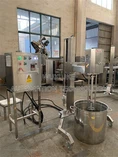
Automatic Filling Machine
Automatic filling machines are a type of liquid filling equipment that can fill many containers with liquid products automatically, without requiring manual intervention.These machines are designed to handle a wide range of liquid products, including water, juice, oil, pharmaceuticals, chemicals, and more.There are several types of automatic filling machines available on the market, including gravity filling machines, piston filling machines, and volumetric filling machines.


Advantages of Automatic Filling Machine
Reliability and consistency
Automatic filling machines permit a repeatable, reliable and consistent fill cycle whether the fill is based on a level of produce, the volume of produce, the weight of produce or another such measurement. Automatic fillers remove inconsistencies and eliminate uncertainty from the filling process.
Higher speeds of operation
The most apparent benefit of automatic filling machines is the higher speeds of operation that they offer. Automatic fillers use power conveyors and multiple filling heads to fill more containers per cycle whether you are filling thin, free-flowing products like water and certain powders, or highly viscous products such as jelly or pastes. Hence, the production is faster when using automatic filler machines.
Simple control interface
Most modern filling machines come with an easy to operate touchscreen interface and are controlled by PLCs. Indexing times, pump speeds, fill times and other similar parameters can be easily and quickly set up by the operator. The ‘configuration' is recorded by the PLC so it can be reused in the future.
Versatility
Automatic Filling Machines can be configured to handle a range of products and container shapes and sizes. The right packaging filling machine offers ease of changeovers with simple adjustments for companies that package multiple products. This allows the downtime to be minimised and production maximised.
Professional team
JKE is a 100% customer driven company. We offer customization to any equipment we sell if it is safe and demanded by customer. Our engineer team are always ready to help customers design new equipments for their innovative research and industry production.
Production market
Our JKE Equipment is exported to South Africa, Czech Republic, United States, Argentina, Belgium, Egypt, Malaysia, Indonesia, Saudi Arabia, Britain, Australia, Philippines and other countries.
After-sales service
Except in-depth knowledge, rich experience and customer-oriented design in industrial automation and machinery, we offer you good after-sale services. JKE have the most professional after-sales team to serve the domestic and overseas markets.
Certificate
① A High Efficiency Emulsifying Homogeneous Production Equipment
Patent No: 2018216906490
② A Synthetic Equipment for Urea-based Lubricating Grease
Patent No: 2018216906518
③ An Industrial Production System of Salad Sauce
Patent No: 2018216911094
④ An On-line AES High-efficiency Dissolution Homogenization System
Patent No: 2018216911215
Considerations for Choosing the Right Automatic Filling Machine
One of the first things to consider when choosing an automatic filling machine is the type of product that needs to be filled. Different products have different viscosities and consistencies, and the filling machine should be able to handle them accordingly. For example, liquids, creams, and powders require different types of filling machines.
Another key consideration is the production speed required. Depending on the demand and production capacity, it is important to select a filling machine that can keep up with the required speed without compromising on quality. Filling machines are designed to maximize productivity and efficiency, offering high-speed filling capabilities without compromising on accuracy and precision.
Additionally, it is crucial to consider the container types and sizes that the filling machine can handle. Whether it is bottles, cans, pouches, or jars, the machine should be compatible with the specific container types used in your production line. Filling machines are engineered to handle various container sizes and types, providing a versatile solution for different packaging needs.
The level of automation and ease of use are also essential factors to consider. An automatic filling machine should be user-friendly and require minimal operator intervention. Filling machines are equipped with user-friendly interfaces, easy-to-use controls, and advanced automation features, enabling smooth operation and reducing the risk of errors or downtime.
Another important consideration is the reliability and durability of the filling machine. Investing in a high-quality, reliable machine ensures consistent performance and longevity, minimizing downtime and maintenance costs.
Cost is always a significant factor to consider when choosing any equipment. While it is important to find a filling machine that fits your budget, it is equally important to prioritize quality and performance. Investing in a reliable and efficient filling machine may have a higher upfront cost but can lead to long-term savings due to increased productivity and reduced maintenance requirements.
Food and Beverage Industry
One of the most prominent industries that benefit immensely from automatic filling machines is the food and beverage industry. Whether it's filling bottles with liquid beverages, such as water, juice, or soft drinks, or packaging solid food items, such as dairy products, snacks, or condiments, automatic filling machines have streamlined production and packaging processes. By ensuring precise quantities and minimizing wastage, these machines have helped food and beverage manufacturers meet consumer demands efficiently.
Pharmaceutical Industry
Another industry that greatly benefits from automatic filling machines is the pharmaceutical industry. Accuracy and hygiene are of utmost importance in pharmaceutical production, and these machines ensure both. Whether it's filling prescription medications, over-the-counter drugs, or vitamins and supplements, automatic filling machines offer a high degree of precision and consistency. Automatic filling machines are designed to meet the stringent regulations of the pharmaceutical industry, with features like anti-contamination measures and a clean-in-place (CIP) system to maintain hygiene standards.
Cosmetics Industry
The cosmetics industry is another sector that relies heavily on automatic filling machines. From filling jars with creams and lotions to packaging lipsticks, mascaras, and perfumes, these machines ensure precise filling and sealing. With the ability to handle a wide range of product viscosities, automatic filling machines by offer flexibility and efficiency, allowing cosmetic manufacturers to meet market demands swiftly.
Chemical and Industrial Industry
The chemical and industrial sectors also reap the benefits of automatic filling machines. Whether it's filling containers with chemicals, lubricants, paints, or detergents, these machines ensure accurate measurements and minimize spillage, thus enhancing workplace safety. Automatic filling machines are constructed with durable materials and fitted with safety features to handle the unique challenges posed by the chemical and industrial industries.
Building Materials Industry
In the building materials industry, automatic filling machines have made significant contributions to enhancing productivity and reducing manual labor. Whether it's filling containers with adhesives, sealants, or coatings, these machines ensure quick and efficient operations. Automatic filling machines are designed to handle various container sizes, allowing building material manufacturers to cater to different market needs seamlessly.
Types of Automatic Filling Machine
Powder filling machine
Different apparatus are attached to the machine depending on the product. An auger filler, for example, uses a long screw-type mechanism to dispense specific quantities of powder.
Solid filling machine (volumetric)
The product is placed in a hopper and fills containers placed on conveyors. The amount of product packaged is determined by setting the machine to a weight or count setting. Multi-Fill partners with Velec Systems to integrate counting into our food processing equipment.
Liquid filling machine
There are various types of liquid filling machines, but as an example, ordinary liquid fillers work by gravity, pouring liquid into bottles based on weight. Interesting fact: for vacuum liquid filling machines to work with milk bottles and grape wines, the ambient pressure must always be greater than the pressure in the bottle.
Jar/Tin Can filling machine
The machine automatically fills the can or jar and then caps it, with quality pre-sealing and final sealing important features.
Bottle filling machine
Bottle filling machines are either volumetric or vacuum level filling. Manual-filling machines are generally volumetric, while semi-automatic and automatic fillers are vacuum level filling. With volumetric filling, the machine uses a piston within a cylinder to force liquid into a container. While with vacuum level filling, it uses the rim at the top of the container to form an airtight seal around the filling nozzle, and the container is filled to the same height each time.
Pouch filling machine
There are two types of pouch filling machines, premade pouch packaging and form fill seal machines. Premade filling packages products in existing pouches, while the form fill seal machine is used to create pouches before they are filled.
PLC fault
- PLC failure is mainly due to the adhesion of output point relay contacts.
- If the motor is controlled by this point, the motor runs after the signal is started by the motor, but the motor does not stop after the signal is stopped and the motor stops running when the PLC is out of power. If the point controls the solenoid valve, the failure phenomenon is that the coil of the solenoid valve is continuously energized, and the cylinder does not reset. If the external force hits PLC to separate the adhesion points, it can help to determine the fault.
- There are two maintenance methods for the failure of PLC output point. A more convenient one is to use a programmer to modify the program. The damaged output point is changed to the standby output point and the line is adjusted at the same time.
Proximity switch fault
The filling machine has five close switches. The three is for knife protection, and the other two for controlling the upper and lower membrane release motors. Among them, one or two times of incorrect action are used to control knife protection. It will interrupt the normal operation process, and it will bring some difficulties to failure analysis and elimination due to the short number of failures and the short time. The cause of the failure is that the knives are not encountered during the descent. When the knife reaches the switch and loses the signal, it contacts the cutter head plate to the package, and the melting knife automatically returns upward. The fault repair method can install a switch of the same type in parallel with the switch and raise the position of the melting knife, so as to improve the reliability of the switch.
Malfunction of magnetic switch
The magnetic switch is used to detect the position of the cylinder and control the stroke of the cylinder. The four cylinder actions of stacking, pushing, pressing and melting knives are interrelated, and magnetic switches are used to detect and control their positions. The main trouble is that the following cylinder does not move, because the cylinder speed is relatively fast, resulting in the magnetic switch can not detect the signal. If the pushing cylinder speed is too fast, after pushing the bag to reset, the pressure pack and the cylinder do not move.
Malfunction of solenoid valve
The failure of solenoid valve is mainly due to the failure of the cylinder to operate or not reset, because the electromagnetic valve of the cylinder can not reverse or blow. If the solenoid valve is blowing, the air pressure of the machine can not reach the working pressure because the air inlet and outlet are connected. The maintenance method is to clean the solenoid valve and replace the damaged sealing ring.
Infeed pan or hopper
Each machine has a location to deposit product in bulk in preparation for the dosing process. Each include a trough-shaped hopper where product can be loaded (by operators or our integrated bulk feeders) and conveyed into a discharge hopper.
Discharge Hopper
The discharge hopper is a funnel-shaped component into which product is fed in preparation for sizing doses. New hopper designs go beyond simply funneling product into the filling head. Our discharge hoppers can also be upgraded to a “jacketed” style hopper which can circulate hot water within the discharge hopper, which assists with product flow in some cases by keeping the product warm.
Filling head
The filling head is the part that actually interfaces with the packaging (jar, bottle, tray, etc.) and from which the product is actually delivered into it.
Mechanical drive system
The mechanical drive system is the expertly engineered mechanism that operates the machine in a carefully automated, perpetual series of metered doses of products. It is timed and automated to ensure that the dispensing of doses is synchronized with the movement of the containers. Our belt can be driven by a motor and gearbox with a chain and sprockets, or we can incorporate a drum-roller style design.
Sensors and signals
Sensors and signals are essential to the correct automation of our filling systems. at any given moment, our sensors synchronize products and containers by checking if there is a container to fill, whether there is enough product in the chute to dispense into the container, and whether safety covers are in place. Signals are sent and received between all the machines on the line to start, end or resume filling. Together the sensors and signals ensure that the filling process runs safely, continuously, accurately and without waste.
PLC control system
Programmable logic controllers (PLCs) are the mini-computers built into our systems, which enable the control and automation of the production line. The PLC can control the speed of the process and the volume of product to be dispensed, among other functions. The PLC is programmed, monitored and adjusted through the human-machine interface.
HMI control system
The human-machine interface (HMI), is the touch screen or button-operated system, where the operator controls the machine and monitors its functions. We have upgraded our HMI to have a completely symbol and image based interface. This enables operators of any language to use the machine without language barriers or confusion.
Lubrication is Key
Regular lubrication of moving parts reduces friction, preventswear and tear, and extends the machine's lifespan. Use the lubricants recommended by the manufacturer to ensure compatibility.
Regular Inspections
Establish a regular inspection program to check for signs of wear, loose components, or any anomalies in the machine's operation. Early detection of potential issues can prevent costly repairs and downtime.
Prompt Parts Replacement
Keep an inventory of critical spare parts to avoid delays in case of a breakdown, most OEMs suggest a critical care parts kits when purchasing the machine. Identifying and replacing worn-out parts is essential in preventative maintenance.
Seal Replacement
Seals and gaskets frequently wear out in sauce filling machines, it's essential to regularly check and replace them immediately at first signs of deterioration. Replacing seals and gaskets will help to avoid leaks and ensure the precision and uniformity of your filling operation.
Software Updates
Keep ntegrated software up to dated for bug fixes, performance improvements, and new features that can enhance machine operation.
Operator Training
Training operators on the correct use and maintenance of the filling machine is crucial. Misuse can lead to accidents, inefficiencies, and machine damage. Regular refresher courses can help keep operators informed about best practices.
FAQ
We're professional automatic filling machine manufacturers and suppliers in China, specialized in providing high quality OEM service. We warmly welcome you to buy custom made automatic filling machine at competitive price from our factory.
Mayonnaise Mixer Machines, 100L Mayonnaise Processing Machine, Hydraulic Lifting Vacuum Emulsifying Machine