




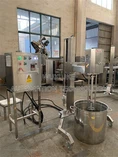
Stainless Steel Mixing Tank
Stainless-steel mixing tanks or “liquiverters” are high speed shear mixers that effectively incorporate dry material particles into a solution or a liquid product. They are used in production lines with a need for quick and efficient mixing of products. A stainless steel mixing tank is a device used for mixing and stirring liquids, with the core component being a stirrer, which rotates to achieve the purpose of mixing materials.Stainless steel mixing tanks are usually made of high-quality stainless steel materials, such as 304, 316, etc. These materials have the advantages of corrosion resistance, high temperature resistance, and high strength, which can ensure the service life and safety of the equipment.


Advantages of Stainless Steel Mixing Tank
Corrosion Resistance
One of the key advantages of stainless-steel mixing tanks is their excellent corrosion resistance. Stainless steel is highly resistant to rust, oxidation, and chemical reactions, ensuring that the tank remains durable and maintains its integrity even when handling corrosive substances. This makes stainless steel mixing tanks suitable for various industries that deal with aggressive materials.
Hygienic Properties
Stainless steel is inherently hygienic, making it an ideal choice for industries such as food and beverage, pharmaceuticals, and cosmetics. The smooth and non-porous surface of stainless steel prevents the accumulation of bacteria, contaminants, and odors. It is easy to clean and sanitize, ensuring that products remain free from contamination and meet strict hygiene standards.
Strength and Durability
These tanks are known for their strength and durability. They can withstand high pressures, temperature variations, and rigorous mixing processes without compromising their structural integrity. This longevity translates into reduced maintenance costs and increases operational efficiency for industries that rely on continuous production.
Temperature Control
They have excellent thermal conductivity properties, allowing for efficient temperature control within the mixing tank. This feature is crucial for industries that require precise heating or cooling during the mixing process. Stainless steel tanks can maintain consistent and uniform temperatures, ensuring optimal product quality and process efficiency.
Professional team
JKE is a 100% customer driven company. We offer customization to any equipment we sell if it is safe and demanded by customer. Our engineer team are always ready to help customers design new equipments for their innovative research and industry production.
Production market
Our JKE Equipment is exported to South Africa, Czech Republic, United States, Argentina, Belgium, Egypt, Malaysia, Indonesia, Saudi Arabia, Britain, Australia, Philippines and other countries.
After-sales service
Except in-depth knowledge, rich experience and customer-oriented design in industrial automation and machinery, we offer you good after-sale services. JKE have the most professional after-sales team to serve the domestic and overseas markets.
Certificate
① A High Efficiency Emulsifying Homogeneous Production Equipment
Patent No: 2018216906490
② A Synthetic Equipment for Urea-based Lubricating Grease
Patent No: 2018216906518
③ An Industrial Production System of Salad Sauce
Patent No: 2018216911094
④ An On-line AES High-efficiency Dissolution Homogenization System
Patent No: 2018216911215
How To Choose Stainless Steel Mixing Tank
Material Compatibility
Consider the chemical compatibility of the tank material with the substances being processed. The tank material should resist corrosion and degradation caused by the materials being mixed.
Mixing Tank Design
Determine the appropriate tank design based on your process requirements. Consider factors such as with hinged lids vs. with top manway, jacketed vs. non-jacketed, and the need for insulation.
Agitator Type
Select the appropriate agitator type based on the characteristics of the materials and the desired mixing effect. Common agitator types include paddle agitators, turbine agitators, helical agitators, propeller agitators and anchor agitators
Mixing Tank Capacity
Choose a tank size that accommodates the volume of material to be processed. Consider the available space in your facility and ensure that the tank capacity aligns with your production requirements.
Temperature Control
If temperature control is critical to your process, opt for a jacketed tank that allows for the circulation of heating or cooling fluids. Consider insulation for better temperature retention.
Use of a Stainless Steel Mixing Tank
The design structure and configuration of a mixing tank, which is used to stir, mix, blend, and homogenize materials, can be standardized and humanized based on the requirements of the manufacturing process. In the mixing process, mixing tanks can be achieved through feed control, discharge control, mixing control, and other manual automatic controls. Structure of a mixing tank The mixing tank comprises the components: The mixing tank body, the mixing tank cover, the agitator, the support, the transmission device, the shaft sealing device, and so on. Depending on the process requirements, it can also be fitted with a heating or cooling device.
The tank body, cover, agitator, and shaft seal can be made of carbon steel or stainless steel, depending on the process requirements.
The stirring tank body and cover can be sealed together with a flange or welded connection. Feeding, discharging, observation, temperature measurement, pressure measurement, steam fractionation, safety venting, and other process pipe holes can all be accessed through the stirring tank body and cover.
The upper part of the tank cover has a transmission device (motor or reducer) that drives the stirrer in the tank via the transmission shaft.
The shaft sealing device can take the form of a mechanical seal or packing, a labyrinth seal, or something else (according to users' needs to determine).

Applications for Stainless Steel Mixing Tanks
Cosmetics
Cross-contamination is a real danger in the cosmetics industry, as is the development of microbial contaminants. These bacteria can be dangerous to consumers, causing allergic reactions and skin irritation when they use the products. That’s why good manufacturing practices are so crucial to production, and part of that involves making sure that tanks are cleaned and satisfied. Stainless steel storage tanks are easy to clean and resist corrosion that can contaminate products.
Pharmaceuticals
- Pharmaceuticals are another industry that must be on guard against contamination in their products. Along with the potential of an allergic reaction, cross-contamination can, at best, render a medication ineffective, and at worst, alter the product’s intended dosage or cause infection. This makes the necessity to thoroughly clean tanks even more essential.
- This isn’t the only benefit stainless steel has to offer the pharmaceutical industry. Because of the types of chemicals used in pharmaceuticals, there is a high need for nonreactive surfaces when it comes to processing materials. This makes stainless steel an effective choice both for mixing tanks and other operations within production.
Chemicals
Of the applications for stainless steel mixing tanks we have listed, the chemical industry uses some of the harshest and most corrosive materials and processes of all, whether a plant creates laundry detergent or ethanoic acid. The fact that stainless steel is non-reactive and resistant to corrosion is key for the integrity of the product and the processing operation in general. Tanks made of other, more easily corroded materials would need to be replaced more frequently, costing the operation money and productivity.
Check whether there is any serious damage and deformation of device during the transportation, and whether the fasteners is loose.
Adopt the method of embedded anchor bolt to install the device horizontally on a firm foundation.
Please install the device, electrical control device and accessories correctly under the guidance of professionals. Check whether the pipelines are unblocked, whether the installed device is correct, and whether there is damage. Before starting the device, please check whether there are people or objects around, inside and outside the device affecting the normal operation, so as to avoid danger.
Please carry out the trial operation first for a few seconds after the installation. It can not be done until there is no electrical short circuit or abnormal sound.
If a mixing tank is equipped with the mechanical seal, add moderate amount of 10# oil or sewing-machine oil into the lubricating grooves of the mechanical seal before starting the main engine. The coolant should be supplied into the cooling chamber of the mechanical seal so that the mechanical seal can be well lubricated and cooled. The mechanical seal is not adjusted when leaving the factory. After installation, the mechanical seal should be adjusted to the optimal position according to the installation instructions before normal operation. (according to the needs of users).
Please check the bearing temperature, running smoothness, tightness, as well as the condition of meters when the device is in normal operation. The material can not be put into operation until it is confirmed that everything is normal.
Operate the device in strict accordance with the working pressure and temperature marked on the product nameplate so as to prevent danger.
Strictly comply with the regulations concerning cooling, oil injection and other aspects in the operation instruction to maintain the device well.
Generally mixing tanks are normal pressure device, so operate it according to the operation instruction of the normal pressure device. Please check whether the inlet and outlet are blocked if the pressure is too high.
Pay attention to the cleaning and daily maintenance of mixing tanks and batching tanks due to many industries, such as dairy and pharmaceutical industry, have higher standards for production technology.
The loading capacity in a mixing tank should be strictly in accordance with its effective volume. Overloading is strictly prohibited to avoid burning out the motor or damaging the reducer and other components.
Clean all parts, inject lubricating oil everywhere and cut off power supply if the device is not used for a long time.
Shape of Stainless Steel Mixing Tank
The geometry of your industrial mixing tank can have just as much of an impact as the material selection. Common industrial mixing tank bottom configurations are conical, elliptical, and sloped—each of which are best suited for different states of matter, composition, and viscosities.
Conical
The conical design is best for the most complete drainage to a center located drain. This configuration is popular for liquids that blend easily with other liquids or powders, with little risk of unmixed materials gathering beyond the reach of the mixing impeller.
Elliptical
A dished bottom is best when it is important for the impeller to effectively suspend settled materials, and provide maximum batch turnover before draining.
Sloped
Finally, the sloped bottom design directs the liquid flow to a horizontally mounted drain valve or spigot at the bottom of the tank wall.
How to Maintain Stainless Steel Mixing Tank
Description: Before using the mixing tank, the reservoir must be cleaned with fresh hot water and then sterilized with steam. The material filling liquid enters the tank through the material pipe on the fixed cylinder head, or the cylinder cover is opened to pour and output material it should not be packed too full to avoid splashing when the material is stirred, resulting in an unhealthy environment or loss.
Heating method: If the equipment is equipped with a temperature device, first adjust the thermometer to the required temperature, and then supply the power. After use, the power should be cut off, and then the power of the stirrer should be turned off.
Cleaning: After the processing is finished, the remaining materials in the tank should be exhausted. Rinse with warm water as soon as possible, brush off the sticky materials, and then wash the inner wall of the container with alkaline water at 10~50 degrees Celsius, and rinse with clean water. When it is used again next time, Sterilize with hot water or steam for 3 to 4 minutes.
Maintenance: Always pay attention to the working conditions of the sub-equipment and the reducer. When the reducer has insufficient lubricating oil, it should be replenished once every six months and pay attention to the level of the thermal oil. When the equipment is not in use, the interlayer must be cleaned with warm water to avoid salt water. Corrosion, often scrub the cylinder, keep the appearance clean, the inner liner bright, to achieve the purpose of durability.
FAQ
We're professional stainless steel mixing tank manufacturers and suppliers in China, specialized in providing high quality OEM service. We warmly welcome you to buy custom made stainless steel mixing tank at competitive price from our factory.
Stainless Steel Mixing Tank, Mixing Tank with Pump