




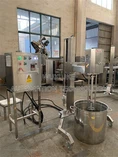
Vacuum Emulsifying Mixer
Vacuum emulsifying mixer means that under vacuum conditions, the material can be uniformly high shear emulsified with a phase or multiple phase distribution or at least another continuous phase. Using the strong momentum brought by the machine, the materials in the stator are subjected to hundreds of thousands of hydraulic shears per minute in the narrow gap. Vacuum emulsifying mixer is agitated by high-quality agitating blades, wall scraping, and center agitation. They complement each other and combine into an optimal agitation method to achieve a perfectly mixed product.


Advantages of Vacuum Emulsifying Mixer
Enhanced Efficiency
The vacuum emulsifying mixer machine streamlines the blending and homogenization process, resulting in significant efficiency improvements. Its robust construction, combined with powerful mixing technology, enables faster processing times, reducing overall production time. This leads to increased output and more satisfied customers.
Precise Mixing
The machine's high-speed rotating blade and built-in vacuum system create a highly controlled environment for mixing. This allows for accurate measuring and blending of ingredients, ensuring consistent quality in every batch. The precision and reliability of the machine eliminate the need for manual intervention, reducing human errors and ensuring product consistency.
Improved Emulsification
The vacuum emulsifying mixer machine excels in emulsification processes, effectively blending substances with different densities and viscosities. With its ability to produce fine and uniform emulsions, this machine can yield superior quality products, such as lotions, creams, and sauces. The emulsion stability achieved eliminates the risk of product separation, increasing customer satisfaction and product shelf life.
Time and Cost Savings
One of the most significant advantages of the vacuum emulsifying mixer machine is its ability to save both time and costs. By minimizing production time and reducing the need for manual intervention, manufacturers can optimize their processes, resulting in substantial cost savings in the long run. The machine's durability and reliability also contribute to cost-effectiveness, as it requires minimal maintenance over extended periods of use.
Professional team
JKE is a 100% customer driven company. We offer customization to any equipment we sell if it is safe and demanded by customer. Our engineer team are always ready to help customers design new equipments for their innovative research and industry production.
Production market
Our JKE Equipment is exported to South Africa, Czech Republic, United States, Argentina, Belgium, Egypt, Malaysia, Indonesia, Saudi Arabia, Britain, Australia, Philippines and other countries.
After-sales service
Except in-depth knowledge, rich experience and customer-oriented design in industrial automation and machinery, we offer you good after-sale services. JKE have the most professional after-sales team to serve the domestic and overseas markets.
Certificate
① A High Efficiency Emulsifying Homogeneous Production Equipment
Patent No: 2018216906490
② A Synthetic Equipment for Urea-based Lubricating Grease
Patent No: 2018216906518
③ An Industrial Production System of Salad Sauce
Patent No: 2018216911094
④ An On-line AES High-efficiency Dissolution Homogenization System
Patent No: 2018216911215
After the materials are heated & mixed in water pot and oil pot, they are drawn into the emulsifying boiler by the vacuum pump.
Adopting the middle stirrer & Teflon scrapers, the emulsifying boiler can sweep the residues on the wall of the boiler. Then the materials are cut off, compressed and folded by the blades. By the strong cutting off force and the impact and turbulent current from the high-speed shear wheel and fixed cutting case, the materials are cut off and turned to particles of 200 nm- 2 um promptly.
Because the emulsifying boiler is under vacuum state, the bubbles that are produced in the course of mixing will be taken away in time.
The pot cover is of automatic rising type. The material is directly drawn into the emulsifying boiler from oil boiler and water boiler.
The discharge is based on the turning of the emulsifying boiler. And the heating system is electric heating and steam heating by the heating pipe, so the temperature is controlled automatically. Put the cool water into the intercalated bed so as to cool the material, which is simple and convenient (there is a warm layer outside the intercalated bed). The homogenizer and the stirring blades can work together or separately. The material sliming, emulsification, mixing, dispersing, etc. can be finished in a short time. Some parts of the vacuum emulsifying machine are made of high-quality stainless steel.

Types of Vacuum Emulsifying Mixer
Vacuum Homogenizer
- This vacuum homogenizer can deform, stir, and homogenize or mix materials. It has a vacuum emulsifier, a platform for operating the machine, and a vacuum system and is controlled by an electric system.
- This machine processes resources in the food industry. It makes gels, creams, and lotions for cosmetics. While the pharmaceutical industry also uses this technology to make ointments, oral syrups, and creams.
- The oil pot, water pot, and operating platform are adjustable to fit the operator's needs. It is made according to CGMP rules, and the parts that touch the products are made from SS316L. This vacuum homogenizer works well with materials that aren't too thick.
Vacuum Planetary Mixer
- This vacuum planetary mixer combines very thick and sticky materials. When it starts to work, the planet carrier spins, which makes the shaft in the box that stirs also spin. This happens
- very quickly around the tank for emulsifying. The strong shearing and kneading of the materials caused by the fast rotation helps emulsify, spread, and mix the materials.
- Inside the mixing tank of this machine is a knife-like scrapper. It helps remove materials stuck to the wall of the mixing tank. This boosts the machine's efficiency by doing so. It can also perform reliably under vacuum and discharge water and other materials. Water or oil may be
- used to heat or cool the mixing tank. This machine features a double column that automatically elevates and lowers its rack, cover, and agitator through hydraulics. The planetary vacuum mixer includes an efficient and user-friendly charge and discharge mechanism.
Vacuum Stainless Steel Mixing Pot
This vacuum stainless steel mixing pot is the simpler option for vacuum mixers. It leaves out other parts of the machine that are unnecessary. This machine is very affordable and works well for industries that only need to mix simple materials. It mixes chemicals for cleaning, soup, building materials, and fluids. Also a "washing pot" because it mixes chemicals used for daily washing.
How to Choose Vacuum Emulsifying Mixer
Material selection: The commonly used materials for vacuum emulsifying mixer are 316 stainless steel and 304 stainless steel. They can be selected according to different production requirements, production environment, and product attributes. The contact materials of vacuum homogenizer emulsifier are all 316 stainless steel.
Emulsification effect: The form of the homogenizers, the shear speed, the tooth structure, the residence time and dispersion time of the material in the dispersion wall, and the number of cycles will all affect the final emulsifying effect. Choose the appropriate emulsifier mixer according to the production needs. Has Vacuum emulsifier homogenous mixing machine for bottom homogenizers, upper homogenizers, internal and external circulation homogenizers, in line emulsification pumps, three-stage emulsifier pumps, etc
Adjustability: Different products require different parameters such as emulsification time, emulsification time and temperature. Therefore, we need to choose an adjustable emulsifier. Mechanical homogenization speed options are 0-3200rpm, 0-4000rpm, 0-6000rpm, 0-10000rpm.
Production capacity: According to production needs, the one that suits you is the best to avoid bottlenecks in production. The minimum workload of the industrial vacuum mixer is one-third of the total.
Daily maintenance: Cleaning and maintenance is required after each use of the vacuum homogenizing emulsifying mixer machine . It is best to use a CIP cleaning system. Choosing a homogenizer that is easy to clean and maintain can reduce production costs and improve work efficiency.
After-sales service. Choosing an industrial emulsifier manufacturer with good after-sales service can better maintain the emulsifier and avoid unnecessary downtime and other failures in production.
Application of Vacuum Emulsifying Mixer
Cosmetics Industry
Vacuum emulsifying mixers are widely used in the production of cosmetics such as creams, emulsions, lotions, and makeup. They can rapidly and uniformly mix various raw materials to form a stable emulsion system, ensuring the consistency and stability of product quality.
Pharmaceutical Industry
In the pharmaceutical industry, vacuum emulsifying mixers are used for the production of ointments, creams, gels, and other pharmaceutical preparations. This equipment can mix drugs and excipients uniformly under vacuum conditions to ensure the uniformity and stability of the drug.
Food Industry
Vacuum emulsifying mixers are often used in the production of food products such as dairy products, sauces, and beverages. They can mix different ingredients uniformly to obtain a stable emulsion or dispersion system, improving the taste and texture of food products.
Chemical Industry
In the chemical industry, vacuum emulsifying mixers are used for the production of emulsions, dispersions, suspensions, and other chemical products. They can rapidly mix various raw materials under vacuum conditions to obtain uniform and stable chemical systems.
Pre-Mixing Properly
Before incorporating ingredients into the vacuum emulsifying mixer, ensure they have been properly pre-mixed first. Pre-mixing helps create a more homogeneous starting mixture and makes the operation of the mixer smoother since it enables the formation of lumps or clumps during the mixing process resulting in a more consistent final product.
Level of Vacuum Optimize Vacuum
With different products requiring different vacuum levels and operating on different viscosity levels, it is important to adjust the vacuum for effective emulsion. Experiment with varying settings of vacuum to find the optimal level of eliminating air bubbles to maintain stable emulsion. Carefully monitor the product during this process to make adjustments if needed.
Temperature Control
Proper temperature control during the mixing process is vital for achieving the desired product consistency and quality. Follow the recommended temperature range for the ingredients being used. If heating or cooling capabilities are available in the vacuum emulsifying mixer, set the appropriate temperature to facilitate emulsification and maintain stability.
Regular Cleaning and Maintenance
Establish a routine cleaning and maintenance routine to keep the vacuum-emulsifying mixer in optimal condition. Clean the equipment thoroughly after each use to prevent cross-contamination and maintain hygienic standards. Follow the manufacturer’s guidelines for cleaning procedures and use approved cleaning agents. Additionally, schedule regular maintenance checks to identify potential issues and ensure all components function correctly.
Operator Training and Expertise
More than proper training of operators is needed to maximize the efficiency of vacuum emulsifying mixers. Since operator expertise would result in smooth operations, efficiency, and minimized errors hence optimizing the used vacuum emulsifying mixer.
How to Install Vacuum Emulsifying Mixer
Examine each valve and switch to ensure that it performs its actual and individual purpose.
Look for signs of consistent rotation, if the sweep wall stirrer is in the proper position and operating correctly, or whether the rotation function has the potential to be crucial.
Verify if there is no water within the heating interlayer before turning on the power. Do not turn the power on when the liquid stage is beneath the heating rod.To ensure proper operation of the steam heating system, make sure that all of the connecting pipes and valves between the steam generator and the vacuum emulsifier mixer are fully functional.
Verify that the electricity indicators, voltage, meters, and other machine components are properly working before continuing.
When in process, the fabric must be heated and stirred simultaneously, under your system and the manufacturer’s production process.
While the fine cloth is present within the pot, the homogenizer may be turned on, and the wall swept simultaneously.The sweep wall stirring speed can be adjustable from the minimum to the maximum, for instance, from zero to the optimum rate.
If the homogenizer fails to operate correctly, the power must be turned off immediately, and the unit must be dismantled and repaired. It is important to extend the vacuum control switch before opening the vacuum pipeline valve when the vacuum pump is activated.
Close the vacuum valve first, and then turn off the electrical supply when the vacuum valve is closed. When the vacuum stress hits a negative value between 0.05 MPa and 0.06 MPa, open the feed valve to allow the water and oil pot substances to get sucked into the vacuum chamber.Additionally, check the filter integrity regularly to verify that no pollution gets into the emulsifying pot and that the homogenizer is functioning correctly.The vacuum created within the emulsifying pot must be kept to a minimum. As a whole, it should be stored between –0.05 MPa and –0.06 MPa to avoid contact with boiling water.
Taking good maintenance of machines is essential when they are in operation. You’ll have to shut off your equipment before leaving the location or facility.
Before the system ceases to operate, it is important to reset the frequency converter to zero and then hit the stirring power switch.
Open the vacuum exhaust valve after shutting off the electrical transmission.
Following removing any products and keeping the pot clean, flush the pot’s interior with warm water to remove any remaining residue.

Mixing Tank
The mixing tank is the primary component of the vacuum-emulsifying mixer. The ingredients for the mixture are kept in a stainless steel cylindrical container. The size of the mixing tank is determined by the size of the produced batch.
High-Speed Disperser
Inside the mixing tank, the high-speed disperser is a spinning blade. It is responsible for dissolving solid substances into smaller particles and is motor-powered. The ingredients are also mixed and emulsified using it.
Low-Speed Mixer
The low-speed mixer is an agitator that moves slowly and aids in properly blending the ingredients. Another purpose for it is to assemble a homogenous mixture. Typically, the low-speed mixer is a scrape-surface agitator that aids in preventing ingredient adhesion to the mixing vessel’s edges.
Vacuum System
A critical component of the vacuum emulsifying mixer is the vacuum system. It is used to eliminate air bubbles from the mixture, which could lead to imperfections in the finished product. In order to avoid ingredient oxidation and extend the shelf life of the finished product, the vacuum system is also used to create a vacuum inside the mixing vessel.
Heating/Cooling System
The temperature of the components being mixed is controlled by the heating/cooling system. High-quality emulsions can only be made with the help of this technology, which also keeps the ingredients from scorching while they are mixed. The ingredients can be heated to a particular temperature or cooled to a particular temperature using the heating/cooling system.
Control Panel
The control panel manages the vacuum emulsifying mixer’s operation. It has controls for the speed of the high-speed disperser, the speed of the low-speed mixer, the temperature of the heating/cooling system, and the operation of the vacuum system. It also has buttons, switches, and displays.
Hydraulic Lift System
The mixing tank is lifted and lowered into and out of the machine using the hydraulic lift system. This method is used to simplify it to remove the finished product from the mixing tank and is operated by buttons on the control panel.
After production, the emulsifying machine must be clean and clean, so as to maintain the working efficiency of the rotor and protect the emulsifying secret seal. If necessary, design and install a cleaning cycle device near the periphery.
After the emulsifier confirms that the sealing cooling water is connected, start the motor, and repeatedly require that the motor steering should be consistent with the steering mark of the spindle before it can operate, and reverse is strictly prohibited!
If liquid leakage is found in the shaft during operation, the pressure of the machine seal must be adjusted after shutdown.
According to the different media used by users, the import and export filters must be cleaned regularly so as not to reduce the amount of feed and affect the production efficiency. The material into the working chamber must be fluid, do not allow dry powder materials, lumps of material directly into the machine, otherwise, it will cause stuffy machine and damage the emulsifier.
It is strictly prohibited to metal scraps or hard and hard sundries into the working chamber of the emulsifying machine, so as not to cause devastating damage to the working stator, rotor and equipment.
Before making the emulsifying machine to formulate the corresponding safety production operation procedures, to ensure the safety of operators and equipment. In the electrical control system, users should set up a safety protection system, and have a good and reliable electrical motor grounding device.
The emulsifying machine needs to check the stator and rotor regularly. If it is found that the wear is too large, the corresponding parts should be replaced in time to ensure the effect of dispersion and emulsification.
When using the emulsifying machine, the liquid material must be continuously input or kept in a certain amount in the container. Should avoid empty machine operation, so as not to make the material in the work of high temperature or crystallization solidification and damage the equipment!
In case of abnormal sound or other faults in the operation of the emulsifying machine, it should be stopped immediately for inspection and then run after troubleshooting. After stopping the machine, the working cavity, stator and rotor should be cleaned.
FAQ
We're professional vacuum emulsifying mixer manufacturers and suppliers in China, specialized in providing high quality OEM service. We warmly welcome you to buy custom made vacuum emulsifying mixer at competitive price from our factory.
Vacuum Emulsifying Mixer