




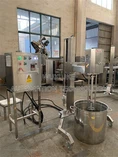
High Shear Mixer
A high-shear mixer utilizes high-speed blades or rotor-stator technology to generate intense shear forces, breaking down particles and droplets in a liquid. High-speed blades spinning at high velocities impart shear forces crucial for particle and droplet breakdown in various industrial processes. Alternatively, rotor-stator configurations create powerful shear forces with a rotating rotor fitted with blades or teeth within a stationary stator. This versatility allows high-shear mixers to meet specific processing needs in different applications.


Advantages of High Shear Mixer
Uniform Mixing: High shear mixers are designed to achieve thorough and uniform mixing of ingredients. They can blend materials of different viscosities and densities, ensuring a consistent product throughout.
Particle Size Reduction: These mixers can reduce the size of particles or droplets in a liquid, resulting in finer dispersions and more uniform textures in products.
Enhanced Emulsification: High shear mixers are particularly effective at creating stable emulsions, which is crucial in industries such as food, pharmaceuticals, and cosmetics where oil and water need to be mixed.
Shorter Processing Times: They work quickly due to the high shear forces generated, which reduces processing time and increases production efficiency.
Improved Product Quality: The uniform mixing and particle size reduction capabilities of high shear mixers contribute to improved product quality, consistency, and stability.
Flexibility: These mixers can handle a wide range of materials, from low-viscosity liquids to high-viscosity pastes, making them versatile tools for different applications.
Professional team
JKE is a 100% customer driven company. We offer customization to any equipment we sell if it is safe and demanded by customer. Our engineer team are always ready to help customers design new equipments for their innovative research and industry production.
Production market
Our JKE Equipment is exported to South Africa, Czech Republic, United States, Argentina, Belgium, Egypt, Malaysia, Indonesia, Saudi Arabia, Britain, Australia, Philippines and other countries.
After-sales service
Except in-depth knowledge, rich experience and customer-oriented design in industrial automation and machinery, we offer you good after-sale services. JKE have the most professional after-sales team to serve the domestic and overseas markets.
Certificate
① A High Efficiency Emulsifying Homogeneous Production Equipment
Patent No: 2018216906490
② A Synthetic Equipment for Urea-based Lubricating Grease
Patent No: 2018216906518
③ An Industrial Production System of Salad Sauce
Patent No: 2018216911094
④ An On-line AES High-efficiency Dissolution Homogenization System
Patent No: 2018216911215
High-Shear Mixer Applications
Common applications of high-shear mixers include emulsification, particle size reduction, dispersion, homogenization, deagglomeration, and wet milling. All of these enhance product quality and production efficiency across various industries.
Emulsification
Emulsification is the process of mixing two immiscible liquids, such as oil and water, to form a stable emulsion. High-shear mixers are commonly used for emulsification in industries such as pharmaceuticals, cosmetics, and food. In the pharmaceutical industry, high-shear mixers are used to produce creams, ointments, and gels. With cosmetics, they are used to produce lotions, moisturizers, and sunscreens. And in the food industry, they produce sauces, dressings, and various condiments. Benefits include improved product stability, reduced processing time, and increased production efficiency.
Particle Size Reduction
Particle size reduction is the process of reducing the size of particles in a liquid or solid to improve their properties or performance. High-shear mixers are used for particle size reduction in industries such as chemicals, pigments, and coatings. Benefits of using high-shear mixers for particle size reduction include improved product quality, increased production efficiency, and reduced processing time. They also produce uniform particle sizes, which leads to improved product performance.
Dispersion
Dispersion is the process of mixing two or more substances to form a homogeneous mixture. High-shear mixers are used for dispersion in industries such as paints, coatings, and inks. Benefits of using high-shear mixers for dispersion include improved product quality, increased production efficiency, and reduced processing time. They also produce smaller particle sizes, which again leads to optimal results.
Homogenization
In various industries, homogenization plays a pivotal role in creating a consistent and uniform mixture by reducing particle size. High-shear mixers are a solid solution for this. In the food industry, for instance, homogenization is indispensable for producing smooth and consistent textures in products like sauces, creams, and dairy items. The precision and efficiency offered by high-shear mixers make them ideal for achieving the desired homogenization results.
Deagglomeration
Deagglomeration is a critical step in improving the quality and performance of products, particularly when agglomerated particles impact formulations. High-shear mixers break up agglomerated particles efficiently. For example, in the production of fertilizers, deagglomeration ensures an even distribution of nutrients, contributing to the efficacy of the final product.
Wet Milling
High-shear mixers play a crucial role in wet milling, a process that involves milling solid material in a liquid to create a slurry. High-shear mixers are commonly used in the pre-mix stage (before processing with a mill). The pre-mix step is incredibly important for mill longevity, reduced processing time, and optimal results, but often underutilized due to ignorance or misunderstanding. In the pharmaceutical industry, wet milling is employed to break down active pharmaceutical ingredients into smaller particles, enhancing bioavailability.
Processing Vessel
This is where all the product mixing occurs. It has a very large volume of around 600 liters with its operational rpm reaching 900.
Silicon rubber ensures that you can hermetically seal the lid during processing. The lid contains an exhaust airport, spray nozzle port and a port for the funnel used in manual feeding.
Chopper
This is majorly used producing fine particles after breaking down the batch material. Their motion is exceedingly ranging between 1500 to 3000 rpm.
This is in order to completely disintegrate the material into the desired fine particles. Such speeds are only possible if a motor propels the chopper blades.
Agitator
- This Z-shaped component is located inside the processing vessel.
- For instance, a 3 blade agitator will produce denser granules.
- Remember, the high shear rpm plays an integral role in quality material processing.
- In as much as a 2-blade agitator is slower, the rate at which the material is mixed is still quite significant. Agitators are usually motor-driven coupled with a gear at right angle to the motor.
Spraying Nozzle
- It is an important component in wet granulation. Of course, it works alongside the high shear mixer pump.
- It uses a peristaltic pump to inject a binder liquid to mix with material inside the mixing container. You will find most of the spray nozzles positioned just above the material requiring granulation. This ensures the spraying is efficient.
- Contrariwise, different mixers may have spray nozzle position varying. It depends on high shear mixing equipment design.
Rotor and Stator (High Shear Mixer Head)
The systems help to create a motion (on impeller) that helps to breakdown and mix products. Its efficacy determines quality of the final mixture.
Software Unit
Most mixers have fully automated systems with interactive HMI. This also integrated with the PLC which help in the automation system.
Chassis, Column or Support
The form that basic structure that hold other components in the high shear mixing machine. The design varies depending on the machine design.
Discharge Unit
Final products leave the system through this section. It functions by using valves and a discharge cylinder powered by compressed air.You will find the location of the discharge valve just below the mixing container.
Operating Principle of High Shear Mixers
High shear mixer is a fluid any liquid or gaseous substance that is free to flow and is not bound nor restricted by any surface effects. The study of the behavior of fluids is known as fluid mechanics. Fluids, like solids, can experience force, stress, or pressure. A flowing fluid experiences shear stress, which is the driving principle of high shear mixers.
Shear stress in fluids is primarily caused by friction between the fluid molecules due to viscosity. Friction between fluids and a moving body also creates shear stress.
The moving body and the fluid molecules in direct contact have the same velocity which is known as the no-slip condition. Intermolecular forces act between the fluid molecules and the surface of the body, known as the boundary layer, resulting in attraction. Once a steady state is achieved, the velocity profile is linear. There is no more acceleration and no more force to deform or shear the fluid. Motion is transferred across each layer of the fluid and is countered by its viscosity.
Laminar flow happens when the fluid is flowing evenly without any disruption across these layers. Adding different bodies to cause shearing forces acting in different directions disrupts this flow. This type of flow, known as turbulent flow, is chaotic causing mass transfer across the fluid layers. Uneven flow across layers of fluid also causes mass transfer. This is effective in breaking up droplets suspended in the mixture causing emulsion, dispersion, and homogenization of the components.
High shear mixers generally have two main parts: the rotor and the stator. This assembly is known as the mixing head or generator. The rotor accelerates the fluid tangentially. The inertia of the fluid, keeps it from flowing together with the rotor. The fluid flows towards the shear gap or the region between the rotor tip and the stator. Inside the shear gap, high velocity differentials and turbulent fluid flow is present producing high shear rates.
The rotor and stator profile, their configuration relative to one another and other features such as holes and slots, contribute to creating the desired fluid flow depending on the application. Below are some of the processes performed by high shear mixers.
The goal of essentially all industrial mixing applications is to achieve a process result of a homogeneous fluid product, i.e. one of consistent physical makeup throughout the batch. Depending upon the properties of the liquids and perhaps solids included in the ingredients this may be achieved through the use of rotating mixers utilizing low shear or high shear mixing techniques. The term shear refers to the stress imparted to the liquid and suspended particles, if applicable, as a result of encountering a mixing blade or impeller. The amount of shear is dictated by the blade design and its rotational speed.
Miscible materials that mix readily from flow and turbulence in the tank are generally achieved using a low shear mixing arrangement. There are a multitude of mixing impeller designs available for miscible liquids blending and solids suspension. Hydrofoil impellers, marine style mixing propellers, axial flow turbines and radial flow turbines are all flow-producing impeller designs.
The hydrofoil provides the gentlest agitation with the least shear. Its blade profile creates nearly uniform flow with the minimum required horsepower input and is especially effective for materials that can be damaged by a high speed and therefore higher shear impeller. Large diameter hydrofoils of one-third of the vessel diameter driven at low rpm are often selected for agitation of large miscible batch applications. Marine style propellers and axial flow turbine impellers are common as well. Axial flow turbines are fabricated similarly to hydrofoils but with large, flat blade surfaces at 45-degree angles to contact and therefore push more viscous materials. Primarily used for flow-controlled processes with higher viscosities, the blade edges provide higher shear and require greater horsepower to drive them.
High shear mixing is utilized for ingredients that resist blending easily. Examples include liquids of differing viscosities or that contain solids that must be broken down or require vigorous action to evenly distribute.
Dispersion is a common form of high shear mixing. Dispersion is a high-speed, high-shear process requiring more horsepower to successfully achieve than simple agitation for similar batch sizes. A deep vortex with visibility to the top surface of a sharp-edged blade is desirable. As the dispersion blade turns, particles contact the blade and are broken apart. In the intense turbulence surrounding the blade, particles collide at high speeds and are further broken apart. Beyond the blade tips the reduced-sized particles are dissolved or dispersed by the horizontal laminar flow extending from the blade. The flow then divides into upward and downward components at the vessel wall ensuring complete circulation.
Things to Keep in Mind While Choosing a High-Shear Mixer
Application-Specific Requirements
The first step in choosing a high-shear mixer is understanding the unique requirements of your application. Consider factors like the viscosity and consistency of the materials you'll be processing, desired batch size, and any special mixing or dispersion needs.
Mixer Type and Design
There are various types of high-shear mixers, each designed for specific applications. Rotor-stator mixers are ideal for emulsification and dispersion, while colloid mills excel in particle size reduction. High-speed dispersers are versatile and can handle a wide range of tasks. Evaluate which type aligns best with your processing goals.
Capacity and Scale
Consider the volume of material you'll be processing. High-shear mixers come in various sizes, from laboratory-scale models for research and development to large-scale industrial mixers for high-volume production. Choosing the right capacity ensures optimal performance and efficiency.
Material Compatibility
Different materials have varying properties, including viscosity, density, and abrasiveness. Ensure the high-shear mixer you choose is compatible with the materials you'll be working with. This prevents issues like clogging, excessive wear, or ineffective mixing.
Mixing Speed and Shear Rate
The speed at which the mixer operates affects the intensity of the mixing action. Higher speeds result in greater shear forces, which may be necessary for tasks like emulsification or dispersion. Consider the required shear rate for your specific application and select a mixer with adjustable speed settings.
Ease of Cleaning and Maintenance
Efficient cleaning and maintenance are crucial for the longevity and effectiveness of your high-shear mixer. Look for models with easy-to-clean components, quick disassembly features, and materials that resist corrosion and buildup.
Safety Features and Compliance
Ensure the high-shear mixer meets industry safety standards and regulations. Look for features like emergency stop buttons, safety interlocks, and protective covers. Compliance with industry-specific certifications and guidelines is essential, especially in regulated industries like pharmaceuticals.
Maintenance of High Shear Mixers
Cleaning of High Shear Mixers
Proper cleaning is essential in extending the lifespan and enhancing the performance of high shear mixers. Here are some key points to consider:
a) Daily Cleaning: After each use, flush the mixer with warm water and a mild detergent to remove any residues. Pay attention to hard-to-reach areas and ensure all parts are thoroughly cleaned.
b) Disassembly and Cleaning: At regular intervals, disassemble the mixer and clean each component individually. Soak removable parts in a cleaning solution to help eliminate stubborn residues. Ensure that all parts are free of debris before reassembling.
c) Safety Precautions: Prior to cleaning, always ensure the equipment is unplugged and the power supply is disconnected. Wear appropriate personal protective equipment (PPE) to prevent injuries while handling cleaning solutions or sharp components.
Inspection of High Shear Mixers
Regular inspection is vital to detect any signs of wear and tear, as well as identify potential issues that may arise. Here are some key points to consider:
a) Visual Inspection: Examine the entire machine for any cracks, corrosion, loose connections, or signs of damage. Pay close attention to the sealing area, shafts, and impeller blades. Any irregularities should be addressed promptly to avoid further damage.
b) Bearing Inspection: Bearings play a critical role in the smooth operation of high shear mixers. Regularly inspect bearings for signs of overheating, excessive play, vibration, or noise. Worn or damaged bearings should be replaced promptly to prevent breakdowns.
c) Shaft Alignment: Incorrect alignment of the mixer shaft may result in excessive vibrations, decreased performance, and premature wear. Regularly check the alignment and adjust if necessary using appropriate tools or seek professional assistance.
Lubrication of High Shear Mixers
Proper lubrication helps reduce friction, minimize wear, and ensure smooth operation of high shear mixers. Here are some important points to consider:
a) Lubrication Schedule: Follow the manufacturer's recommendations regarding lubrication intervals and types of lubricants to use. It is crucial to adhere to these specifications to extend the life of the mixer.
b) Lubrication Points: Pay attention to lubricating key components such as bearings, seals, gears, and other moving parts. Apply the appropriate lubricant or grease as per the manufacturer's guidelines.
c) Excess Lubrication: Be cautious not to over-lubricate as it may lead to leaks or attract dust and debris, causing additional problems. Follow the recommended quantities and application methods.
Troubleshooting Tips of High Shear Mixers
High shear mixers may encounter technical issues during operation. Here are some common problems and troubleshooting tips:
a) Motor Overheating: If the motor overheats, check for any obstructions blocking the air vents and remove them. Ensure proper ventilation and, if necessary, inspect the motor for faulty wiring or issues with the cooling system.
b) Excessive Noise or Vibration: Examine the machine for loose bolts, misalignment, or worn-out bearings. Tighten loose components, realign shafts, or replace damaged bearings as needed.
c) Leaking Seals: Leaks around seals can lead to contamination and reduced efficiency. Regularly inspect and replace worn-out seals promptly to prevent leaks.
FAQ
We're professional high shear mixer manufacturers and suppliers in China, specialized in providing high quality OEM service. We warmly welcome you to buy custom made high shear mixer at competitive price from our factory.
High Shear Mixer, Automatic High Shear Homogenizer